Asphalt Paving for Schools and Public Facilities: What to Expect
Paving a school, library, or other public facility isn’t the same project as paving a private driveway or standard commercial lot. Active campuses can’t simply shut down for construction, pavement often has to support a wider mix of traffic, and project timing has to work around an institution’s calendar — not the other way around.
Why Institutional Pavement Needs a Different Approach
Public facilities typically see heavier, more varied traffic than a standard commercial lot — buses, delivery vehicles, and high pedestrian volume all at once. That combination often calls for thicker asphalt sections and more robust base construction than a comparable private parking lot would need, simply to hold up under the load.
The Academic Calendar Is the Planning Window
Summer break is the single best opportunity for school paving projects — an empty campus means full-lot access and the ability to complete work in days that would otherwise require weeks of phasing around students and staff. Projects that miss this window often get broken into smaller phases scheduled around breaks, weekends, and off-hours instead.
Phased Work on Active Campuses
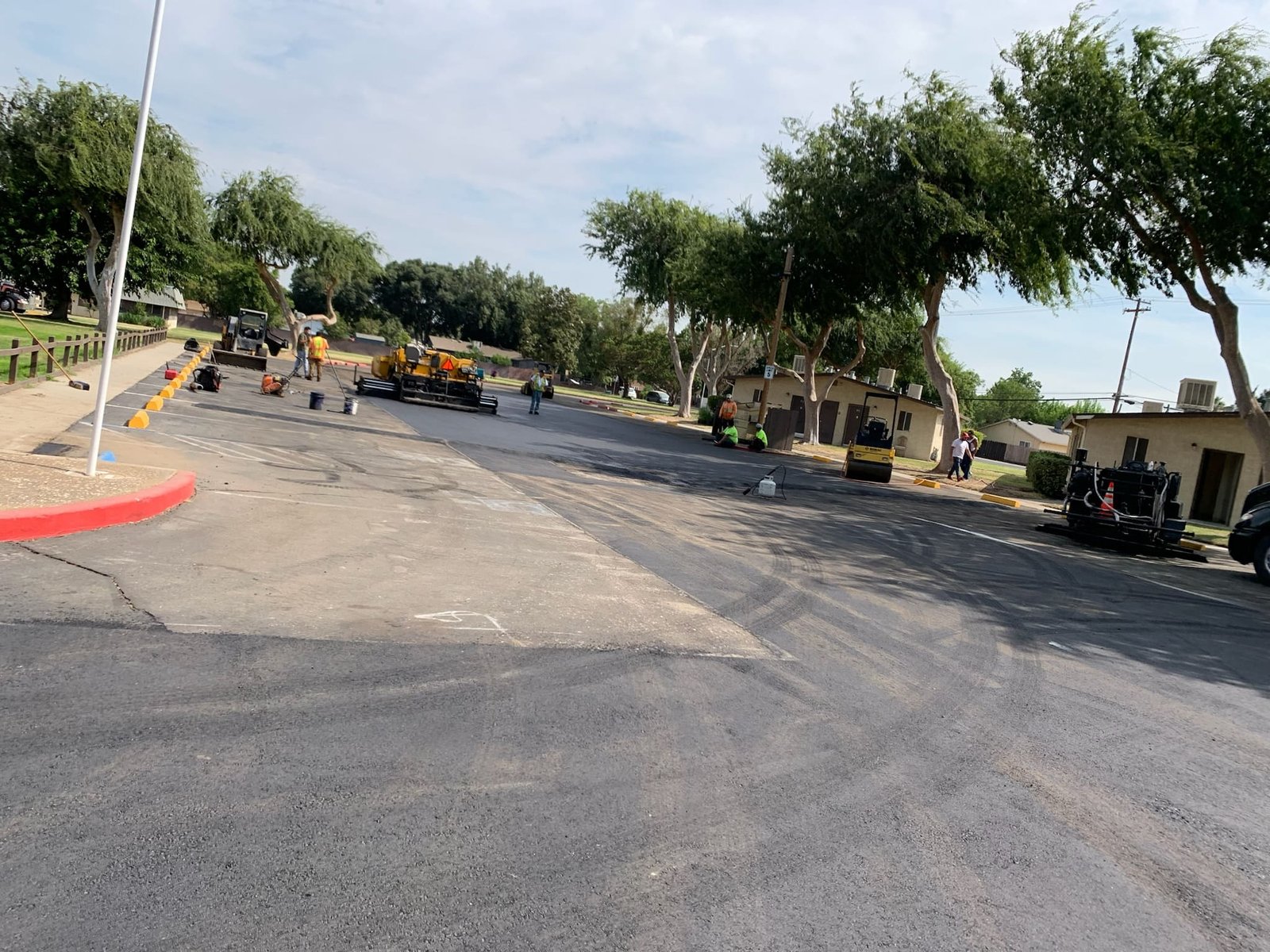
When a project can’t wait for a full closure window, phased scheduling keeps part of a lot or roadway open while work proceeds on another section. This requires more coordination than a standard commercial job — clear communication with facility administrators, careful sequencing, and sometimes night or weekend work to avoid interfering with daily operations.
ADA Compliance Matters Even More Here
Public buildings are held to accessibility requirements at least as strictly as private commercial properties, often more so given the volume and diversity of visitors. Any paving or restriping project on a public facility is a good opportunity to confirm that accessible spaces, access aisles, and signage are fully up to current standards.
Questions Facility Directors Should Ask a Contractor
- Can the project be phased to avoid a full closure?
- Does the contractor own their equipment and crews, or will work be subcontracted? (Subcontracted work introduces more scheduling risk on a tightly phased institutional project.)
- What’s the plan for weekend or after-hours work if needed?
- How will drainage and grading be handled given the facility’s existing traffic patterns?
- Will a written, multi-phase scope be provided to support budget approvals without re-bidding each section?
Why Deferred Maintenance Costs More at Institutions
Because public facility pavement supports heavier traffic and carries real liability exposure — pedestrian safety, bus access, emergency vehicle routes — deferred maintenance tends to escalate faster here than on a typical commercial property. A cracked or pothole-riddled lot isn’t just an eyesore at a school or public building; it’s a safety and liability issue that tends to get expensive quickly once it’s neglected.
Let’s Plan Around Your Calendar
G&S Paving works with schools, districts, and public facilities throughout Northern & Central California, with scheduling built around your academic calendar or operating hours — not a generic timeline.
Frequently Asked Questions
When’s the best time to schedule school paving projects?
Summer break is generally the ideal window, since an empty campus allows full-lot access and faster completion than phased work during the school year.
Can paving work happen while a school or facility stays open?
Yes, through phased scheduling — working on one section while keeping another open, often paired with weekend or after-hours work to minimize disruption.
Why does base construction matter more for schools and public facilities?
These properties typically see heavier, more varied traffic (buses, delivery vehicles, high pedestrian volume), which often calls for thicker asphalt and more robust base than a standard commercial lot.
Do you work with schools and public facilities on scheduling and phased projects?
Yes, G&S Paving works with schools, districts, and public facilities throughout Oakley, Brentwood, Antioch, Concord, Pittsburg, Walnut Creek, Stockton, Tracy, and Fairfield, with scheduling built around each institution’s calendar.